High School
Diving Toolkit
A comprehensive coaching resource specifically designed for real high school programs. Master limited board time, short seasons, and develop confident, skilled athletes.
What This Toolkit Supports
- Efficient practice flow & time management
- Clear skill development pathways
- Building coach confidence & consistency
- Fostering positive team culture
- Season planning & meet preparation
- Safety protocols & risk management
Real-World Tools for High School Diving Coaches
High school diving comes with unique constraints: short seasons, limited facilities, mixed experience levels, and minimal support staff. These featured resources focus on practical solutions that work in real programs.

Learn what you need, in the right order
Six modules that take you from "what am I doing" to running a safe, organized, confident program. Click any module to expand it.
Before you coach a single dive, you need to know what safe looks like and what your school, state, and program require of you. This is not just legal protection. It's the foundation everything else is built on.
Understand
- What NFHS requires of high school diving coaches
- How to inspect equipment before every practice
- What progressions are safe for beginners vs. what to never rush
- Your duty of supervision and how it differs from club coaching
- When to say no to dives, to pressure, to athletes pushing past readiness
Do This
- Complete the NFHS Fundamentals of Coaching course
- Complete the NFHS Coaching Diving course
- Walk your facility and document anything that needs attention
- Learn your school's policies on injury reporting and supervision
Resources
You don't need to be an expert on every dive, but you need a working vocabulary. If you can't read a dive sheet, understand what judges look for, or explain a forward 1.5 to a parent, things get hard fast.
Understand
- The six dive categories and how they're numbered
- What "degree of difficulty" means and why it matters
- How scoring works and what judges actually watch for
- The difference between high school and club/NCAA rules
- Basic terminology: hurdle, approach, entry, tuck, pike, layout
Do This
- Watch the dive numbers explained video until categories feel natural
- Read the diving basics packet; it is dense but worth it
- Sit in on a meet as a spectator before coaching one if possible
- Take the NFHS Judging Intro course; it makes you a better coach
Resources
You're probably sharing a pool, managing multiple skill levels at once, and working with limited time. Structure is what keeps things from becoming chaotic and you don't need to invent it from scratch.
Understand
- A typical practice flows: dryland, warm-up, skill work, repetitions, cool-down
- Waiting time is your enemy; plan rotations so athletes are always doing something
- Mixed levels can be managed with simultaneous tasks, not just turn-taking
- Not every practice needs something new; consistency builds confidence
- Your first job is creating a safe, calm environment
Do This
- Watch the practice structure video before day one
- Write a simple practice plan, even a rough one
- Set ground rules on day one: board rotation, when to enter water, signals
- Have a dryland activity ready so athletes aren't standing around
Resources
Knowing how to do something and knowing how to teach it are completely different skills. Most new coaches struggle not because they don't care, but because they don't have a system for turning what they see into feedback athletes can act on.
Understand
- Every dive has three phases: takeoff, flight, and entry; watch one at a time
- Correcting is different from critiquing; one is actionable, the other just discourages
- Feedback should be one thing at a time, not a list of everything wrong
- Use "affirm before correcting"; it actually works and athletes respond better
- Progressions exist for a reason; don't skip steps because an athlete is eager
Do This
- Start with the fundamentals and progressions course; it will change how you watch dives
- Practice your feedback out loud before practice; say it to yourself first
- Pick one thing to focus on per athlete per practice, not everything at once
- If an athlete is afraid, don't push; build the progression back from where they're confident
Resources
High school seasons are short, often 10 to 14 weeks. Without a plan, you'll hit the first meet realizing half your athletes don't have a legal dive list. This module helps you think forward, not just week to week.
Understand
- Athletes need to peak at the end of the season, not the first meet; plan for that
- A dive list has specific requirements; know your state's rules early
- Meet day has its own flow: warm-up time, submission deadlines, judging order
- Your job at meets is athlete support and logistics, not last-minute coaching
- Consistency in the dive list matters more than difficulty early in the season
Do This
- Map out your season calendar in week 1; work backwards from championships
- Learn your state's dive sheet requirements before athletes start learning dives
- Have every athlete's dive list drafted by week 3, even if it changes
- Read through the meet strategy guide so meet day isn't a surprise
Resources
Technique and planning matter, but the thing that determines whether your program grows or whether athletes quit after one season is how practice feels. This module isn't soft content. It's what keeps kids showing up.
Understand
- High school athletes respond to being seen as individuals, not just performers
- Fear of failure is the single biggest barrier to skill development in diving
- Your attitude and energy sets the ceiling for the team's; this isn't optional
- Retention matters more than recruitment: a culture where athletes return is everything
- Mental blocks around dives are real and require patience, not pressure
Do This
- Set clear team norms in week one: how athletes treat each other, how feedback works
- Add one team activity or game per week that has nothing to do with scoring
- Check in with individual athletes, not just their dives
- When an athlete has a mental block, slow down and build back from a place of success
Resources
Ready to go deeper?
The curriculum gives you the foundation. The full resource library has everything else, organized by topic so you can find what you need when you need it.
Browse the Full Resource LibraryWhere are you right now?
Choose the option that sounds most like you and we'll point you to the right resources.
Have you coached high school diving before?
Pick the one that fits you best.
What do you actually need help with right now?
Choose the option that sounds most like what's in your head.
What feels most off right now?
Pick the one that feels closest to the problem.
What's the biggest issue with your practices?
Pick the one that sounds most like your situation.
What part of meets is confusing?
Pick the one that matches your biggest question.
Do you have any diving background at all?
This helps us point you to the right starting place.
What do you need help with?
Pick the path that feels most relevant.
Okay, let's start from zero.
You are not the only one. Choose what feels most urgent.
Want everything in one place?
Browse the Full Resource LibraryDive Sheets, Made Simple
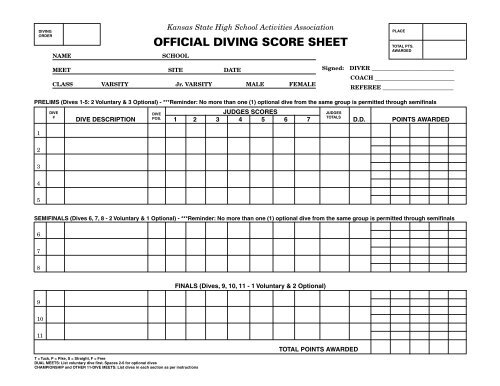
Dive sheets don't need to be confusing. This page provides step-by-step guidance, realistic examples, and downloadable templates to help coaches and athletes build appropriate lists for competition.
Walkthrough: Building a Dive Sheet
A step-by-step video breakdown showing how to construct a realistic, competition-ready dive sheet and avoid common mistakes.
How to Fill Out a 6-Dive Meet Sheet
Six-dive meets use a simple structure, but most errors happen because coaches misunderstand how the voluntary dive works.
In a 6-dive meet, the first dive is always the voluntary dive. The remaining five dives are optional dives.
-
1Confirm the required voluntary category.
For high school meets, the voluntary category is pre-selected by the state diving association and can change weekly. -
2Select a safe, reliable voluntary dive.
The voluntary dive sets the tone for the meet. -
3Build the five optional dives.
At least four of the five dive groups must be represented. -
4Check group coverage.
-
5Verify dive numbers, positions, and DD.
A legal six-dive sheet prioritizes confidence and execution.
How to Fill Out an 11-Dive Meet Sheet
Eleven-dive meets require careful planning because voluntary and optional dives are distributed across multiple rounds.
- → Five dives are voluntary.
- → Six dives are optional.
- → All five dive groups must be represented.
-
1Assign voluntary dives correctly.
One voluntary dive per group within the DD limit. -
2Distribute voluntaries across rounds.
Two in the first five dives, two in the first eight, one across all eleven. -
3Place optional dives strategically.
-
4Ensure all five groups appear within the first eight dives.
-
5Review order, legality, and athlete readiness.
Eleven-dive sheets reward planning and discipline.
Still not sure your 11-dive sheet is correct?
This interactive spreadsheet walks you through the rules, calculates DD,
includes a fillable sample sheet, and helps verify legality before submission.
Choosing the Right Dives
A higher degree of difficulty does not automatically produce a higher score. Judges reward execution first.
Score Comparison:
- Dive A: DD 1.8 × (7.5 × 3 judges) = 40.5 points
- Dive B: DD 2.3 × (5.5 × 3 judges) = 37.95 points
Although Dive B carries a higher degree of difficulty, Dive A earns the higher score due to stronger execution. Higher-DD dives can still outscore simpler dives, but this increases scoring volatility.
Key Takeaway: Coaches must balance risk and reward when selecting dives.
Common Dive Sheet Mistakes
- ⚠ Using the wrong voluntary category
- ⚠ Placing voluntary dives incorrectly
- ⚠ Missing required dive groups
- ⚠ Chasing DD before consistency
- ⚠ Skipping legality checks
Final Coach Check
- ✓ Voluntary legality confirmed
- ✓ Group coverage complete
- ✓ Dive numbers and DD verified
- ✓ Athlete confidence confirmed
How to Qualify for State
State qualification requirements for high school diving are determined at the state level and can vary significantly. There is no universal standard, so coaches must verify the specific rules for their state or governing association.
Common qualification pathways include:
-
①
Score-based qualification.
Some states require divers to achieve a minimum qualifying score in a six-dive and/or eleven-dive meet. These requirements may also include minimum degree of difficulty thresholds. -
②
Placement-based qualification.
Other states qualify divers based on finishing position at a conference, sectional, district, or regional meet, regardless of score. -
③
Hybrid or alternate systems.
Some states use a combination of score requirements and placement, or apply different rules depending on class size or region.
Important: Because qualification rules can change from year to year, coaches should confirm requirements directly through their state high school swim and dive organization before finalizing dive sheets or season goals.
Dive Sheet Template
Printable and editable dive sheet format for both 6-dive and 11-dive meets.
Download TemplateDegree of Difficulty Chart
Official FINA DD chart with all dive numbers and positions for reference.
View DD ChartSample Dive Sheets
Realistic examples by skill level for both 6-dive and 11-dive formats.
View SamplesCertification and Safety
Required and recommended certifications for coaches, plus safety resources every program should have in place before the first practice.
Coach Certifications
Safety Resources
Understanding the Sport
The basics of competitive diving: how it works, how it's scored, terminology, and what makes it different from other sports. A good starting point for coaches, parents, and new athletes alike.
Introductory Overviews
Video Explanations
Technical and Advanced Understanding
Running a Practice
Practice flow, structure, group management, and making the most of limited board time.
Practice Structure and Planning
Group Management
Planning and Periodization
Season planning, periodization principles, and long-term athlete development for short high school seasons.
Start Here
Periodization Guides
Dive Sheets and Judging
List construction, dive numbering, judging criteria, scoring, and competition requirements. Understanding this section makes you a significantly better coach.
Dive Numbers and List Construction
Judging and Scoring
Rules and Regulations
Dryland and Conditioning
Warm-up routines, dryland workouts, conditioning programs, and strength resources. Ready-to-use templates included.
Ready-to-Use Templates
Seasonal Conditioning
Circuits and Cardio
Reference and Technical
Skill Development and Progressions
Teaching dives from the ground up, working with beginner through advanced athletes, and building appropriate progressions at every level.
Beginner Development
Advanced Development
Coaching Communication and Feedback
How you communicate with athletes shapes everything from skill development to retention. These resources cover giving effective feedback, correcting vs. critiquing, and building a coaching style that actually works.
Giving Effective Feedback
Communication Style and Culture
Team Culture and Athlete Wellbeing
Retention, motivation, athlete psychology, and building a program environment athletes actually want to be part of.
Games and Activities
Meet Prep and Competition Mindset
Pre-meet routines, managing anxiety, competition preparation, and keeping athletes composed under pressure.
Video Resources
Recruiting and College Diving
Everything coaches and athletes need to understand the college recruiting process, NCAA eligibility, and what college diving actually looks like.